Questions? Write Me at

Questions? Write me at fullcirclegardener @ cableone . net.

Upcoming Menards Topsy Turvy Planter Deal (April 2011)

Menards has a deal for you if you've ever thought you'd like to check out the Topsy Turvy Tomato Planter!


Friday April 22 through Sunday April 24, the Topsy Turvy Tomato planter is advertised as $0.99 after mail in rebate.  Note that Menards rebates are in-store credit that can be applied to a future purchase.  In this case you will pay $4.99 at the time of purchase and mail in a rebate form & part of your receipt for your $4.00 rebate.

Have you used one of these?  What is your opinion of them?

National Public Gardens Day: May 6, 2011


Better Homes & Gardens is working with many of the nations public gardens to provide free entrance on National Public Gardens Day on May 6.  Minnesota Landscaping Arboretum (Chaska, MN) is included if you feel like a garden field trip on May 6 or know someone near one of the other gardens!  Looks like you can select to have up to 10 people in your group.  Follow this link to sign up and print the voucher.

What a great way to find inspiration for your garden space or landscaping project! :D

Thanks, Money Saving Mom!

Free Sample of 'Thrive'

Request a free sample of Thrive veggie, tomato, flower, new plant, or compost microbial/bacteria treatment here.
Alpha BioSystems manufactures Thrive, a line of  'all-natural products for vegetation, ponds, and pets'.  The sample will make a 1 1/2 gallon of product.


Thanks, Money Saving Mom!

Preparing the Garden Site: Soil test

Snow is gone and it's time to think about preparing the soil for planting!
It's just over 4 weeks until the average first frost-free day in my area, the temps are warming up and the snow is gone!  Guess what that means?!?!  I'm getting the itch to dig in my garden!  It is still far to wet to even begin to consider working in it, but I AM doing a lot of thinking... thinking about what I can do now to prepare my soil for planting and an abundant harvest.

I have read and been told for a number of years that one should have a soil test done on their soil so they have a baseline to build from when amending the soil, and yet I have hesitated to do it.  I have to admit that ultimately I was content with status quo and it seemed like it would be too much work to find out what I needed to do and then to get it done.  Well, for probably the last year it seems like soil testing has been brought up to me over and over and over and over.  At what point do I need to take the hint?!?!  This spring I decided to take the hint and find out what I need to do after my parents had a soil test done on a problem spot in their lawn.  I'm a bit embarrassed to say this, but it was REALLY EASY to find the information!!!

Any county extension agent can get you the guidelines, the form and the address to mail the sample to or you can search "(your state) soil lab" online.  After a quick search I found both the North Dakota soil lab & Minnesota soil lab and all of the information required to submit a soil test to each lab.  I also called the NDSU Soil Lab to clarify the directions for the sample and found out that soil samples can be hand delivered to the lab to save mailing costs for those who are local (the U of M lab's website says to mail & not hand deliver the sample).  As far as I can tell, you do not have to be a resident of either state to submit a sample to either soil lab, but I would consider contacting the lab before you invest time/energy into delivering a sample and then find out they won't/can't do it.

So what do you need to do? Find a clean (not washed w/soap; soap residue may contaminate the sample w/phosphorus) container & collect 2-6 samples of your soil that you will mix together into one composite sample.  Each sample should be free of any surface material (leaves, mulch, grass etc) and taken from 0-6 inches deep for a garden sample or 0-3 inches for lawn.  You will want to dry out the sample as much as you can and then collect 2 cups for the lab to analyze.

I'm hoping to get my garden soil sample collected and delivered in the next week or two.  Have you ever had your soil tested (garden or lawn)?  If so, did you find it helpful?  If not, are you thinking about having a soil test done this year?  I'd love to hear your thoughts & comments!

Happy Gardening!

Mailbox Fun!

My Seeds of Change package arrived today in the mail!  Were you able to get in on the organic seed deal I posted about a few weeks ago?


I got 16 packets of veggies (lots of tomatoes & greens), 9 packets of flowers and 1 herb packet.  I'm excited to try them, and added bonus, some are labeled as heirloom!  I'm looking forward to trying to collect seed from these! :D

Happy Gardening! :D

The Scoop on Raspberries: Maintianing for Optimal Harvest

My summer-bearing (closest) and fall-bearing (furthest away) raspberries before spring cleanup.

In my post on site selection, I explained the basic difference between summer-bearing and fall-bearing (aka: ever-bearing) raspberries and the importance of selecting your site carefully.  In this post I want to cover maintenance for both summer- and fall-bearing raspberries.  Raspberry maintenance is pretty simple, and just a little bit of time and energy spent in the spring will go a long way toward obtaining a larger fruit & more abundant harvest later in the season.

As with any plant, overcrowding will reduce production as the plants compete for water and nutrients.  I have not had a big problem with this.  My raspberries seem to naturally space themselves about 6 inches apart, but if you find your raspberries coming up closer than that, you will want to dig out some of the sprouts.  These sprouts can be replanted in a new location (on your property or someone else's!) or put into a compost pile for future fertilizer.


June-bearing raspberries with tops trimmed off

The canes of summer-bearing raspberries die the fall/winter after they have produced fruit.  These spent canes become a liability to next year's harvest immediately after they are done fruiting.  They consume energy that the plant could otherwise be investing in the canes that will produce next year, therefore it is in your best interest to cut the spent canes off at the ground after harvest is done for the year.  Early in the spring before the leaves break bud, you can trim the top 3 inches or so off the canes to encourage branching and thus a bigger harvest.


Ever-bearing raspberries with all canes cut off & this year's 1st shoot already starting

Fall-bearing raspberries can be handles two different ways.  I cut all of my fall-bearing raspberries off at ground level late in the fall or early in the spring every year.  I do this because I've read & I believe that I do get a better single harvest each fall.  The other benefits are, the fall harvest is it is usually in late August and into September and I'm less likely to need to protect the fruit from birds and insects, and also simplicity!  I don't have to figure out which canes are spent and which are this season's... they are all cut off every year!

The other fall-bearing maintenance method is like that of the summer-bearing raspberries, where the individual spent canes are each cut off after the midsummer harvest leaving the new canes to bear in the fall.  Because the raspberries have to invest energy into two fruit seasons, neither season is quite as productive as one.  The benefit of this concept is, if you have a cool fall or early fall frost, you will have already gotten some raspberries earlier in the year.  (I have eliminated this factor by having both summer- and fall-bearing raspberries.)

"Happy" fall-bearing raspberry canes can grow to be 3-5 ft tall their first year.  If you find your plants are pushing the 5 ft mark, you may want to trellis or stake them up in some way.  This keeps the fruit from weighing the plant down and shading others around it.  In the past I have staked up chickenwire around my everbearing raspberries that I can easily move when I need in to harvest, but I would love to establish some type of permanent 2 or 3 wire trellis/fence that would look nicer.

I hope you find this helpful.  If you have any comments or questions, I would love to hear from you.

Happy Gardening!

The Scoop on Raspberries: Site Selection

My raspberry patch
 We grow both summer-bearing and fall-bearing raspberries in our yard because some members in my family love raspberries almost as much as candy and I love having this treat around for them.  While one needs to consider carefully where they are planted, raspberries take little work or money once established, and produce a delicious treat that are expensive if purchased in the store.  Early spring (now) is the preferable time to establish a raspberry bed and it only takes a few canes to produce a bed as big as you allow it to spread!  We made a couple mistakes when we first planted ours, but a talk with the neighbor and a move later, we happily harvest raspberries every year!  I hope that by sharing my experience you will be able to avoid similar mistakes.

But, before I go any further I want to explain the difference between summer-bearing and fall-bearing raspberries.  Summer-bearing are most similar to their wild relatives, producing fruit mid-summer on two year old canes.  Fall-bearing (also known as ever-bearing) raspberries can produce fruit twice a year.  The new canes produce fruit the fall of their first year and then again the following year mid-summer.

I was both ignorant and in denial the first time I planted raspberries.  We initially planted 3 red & 3 yellow ever-bearing plants along the fence between my garden and the neighbors yard.  I knew that raspberries were a spreading plant, but for some reason I assumed that they would NEVER cross a fenced property boundary OR invade my garden... denial!  It didn't even take the full summer before they invaded both my neighbor's yard & especially my watered garden!

As I did a little more reading I found out that raspberries, strawberries, tomatoes, peppers and some other veggies are susceptible to the same diseases... ignorant!  The last thing I wanted was to have a potential ongoing disease issue in my veggie garden because I had raspberries too close, so we moved them to a new location along the fence (thankfully the above invaded neighbor was happy to harvest from the invaders, so we stayed along the same fence) and added a few canes of summer-bearing raspberries from my mother-in-laws patch.


Yesterday I noticed the first new fall-bearing raspberry shoot as I cleaned out and prepared the bed for this season.  Check out my post on maintaining your raspberries for optimal harvest for more information on raspberry maintenance.

Happy Gardening!

Trimming Trees & Shrubs

 My husband & I spent a significant amount of time outside yesterday.  We have planted a lot of fruit bearing bushes, brambles & trees over the last several years.  We love the produce, but it does mean that each spring we need to prepare them for the coming fruit season.  March is technically the best time to trim most trees & bushes, but this year the abundance of snow held us back a little longer.

Notes: Don't trim any plants (including trees & shrubs) that set their flower buds in the fall (ex: lilacs) until after flower unless you don't want/expect flowers this year.  Also, Maple trees will weep sap if trimmed early in the spring.  While this doesn't hurt the tree, you can wait until after the sap is done flowing if you are worried about it.

Rabbit damage on Nanking Cherry bush

Here are some general guidelines to remember when trimming shrubs & trees:

1) never remover more than 1/3 of the plant a year
2) trim the top narrower than the bottom so that the bottom branches don't get shaded out and die
3) remove any damaged areas (ex: snow/critter damage) - a fresh, 'healthy' cut is less likely to get infected
4) remove any branches that are rubbing the bark off another branch; these places become entry points for infection if left
5) be careful not to trim too deep on juniper or cedar; if trimmed beyond the green area they won't grow back
6) when trimming fruit trees remove any 'waterspouts' - branches that shoot straight up into the air; these don't bear weight well

These are some general guideline.  If you are looking to shape a tree for landscaping architecture or for fruit production you will want to get some more specific information.

Happy Gardening!

Signs of Life

This week most of the snow in my yard has melted.  I went out yesterday to investigate and found some hope instilling signs of life!  :D  The poppy first caught my eye.  I started it last year, from seed my mom collected from her plants.  I planted two, but something ate one off.  This one was such a bright happy green against the wood chips & soil!  I then moved along the flower bed and saw the iris's daring the snow/ice to hold them back and then the tulips bursting forth.  I LOVE the first signs of green in the spring! :D
Poppy- First sign of green!


Irises - Snow/ice I will overcome!


Tulips...
Bursting forth with joy!


There were also so not so exciting views as well...
Floating strawberries!


Why is the garden the last place snow free?


I'm a little worried about my strawberries.  The poor little plants are green & ready for spring but their leaves are floating an inch under the kid's toy boat!  Notice the snow and water in the neighbors yard beyond the fence?  It is flowing right over my strawberries and on down across my yard.  I'm not sure they will be able to survive that much water for very long and there is no where for the water to go since the soil is all saturated. :(

On a happier note... we have had several days of 40 - 60 degree highs and lows not falling below 32.  I'm considering moving my seedlings outside to my new green house! :D  My dad renovated my old greenhouse and created a new and improved one for me.  I am so excited to try it out.  I'm hoping to get some pictures posted over the weekend!

How is your yard and/or garden looking this week?  Are you seeing signs of hope?  or are you finding sad winter/spring kill?

Happy gardening indoors and outdoors! 

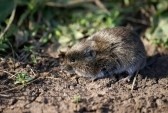
Reader Question: Voles


Reader, Tammy, wrote me with this question: 

     "Do you have any advice on ridding the garden of... voles.  If I don’t get them under control this year, it won’t pay for me to plant the garden. L Last year I lost all my beets, about ½ my peas and green bean, some of my tomato plants,… due to the voles either eating snipping the plants off at the base or from them eating my fruit/veg before I could get to harvest them."

I have no experience with voles.  Do you have any suggestions for Tammy?